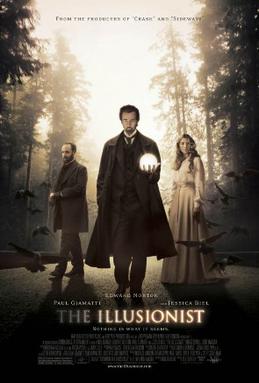
The Illusionist (2006) - First 5 Mins
Camera Work
Sound
The music in this film is all orchestral, this is as the film is set in the 1900s. The music played during the opening credits in mysterious and magical (created by the violins) this gives the audience a sense of what the film is about, as it is about an illusionist named ‘Eisenheim’. Near the end of the opening credits the music becomes faster – increasing the audience anticipation and building suspense, after the increase of speed the music stops all of a sudden, the screen goes black and the first shot is shown. The sudden stop in music creates a bigger contrast between the music played in the credits and the silence in the theatre. The diegetic sounds increase during the scene – starting with the sound of the fire blowing in the wind (which becomes louder when it is in shot), then when the camera has a close up of the character ‘Eisenheim’ you can hearing him breathing heavily showing how hard he is concentrating on his act, rustling is then heard in the background enhancing how silent the character is. The audience then makes noise by whispering, moving about (creaking of chairs creating an eerie atmosphere). Then the non-diegetic comes in, this consists of short notes being played on a xylophone creating an uneasy and mysterious atmosphere for the viewer whilst the spirit is forming. A lady then gasps, and because the sound so far has been quiet this loud gasp shocks the audience. Then more people start to talk, building the texture up more and more, by using all these diegetic sounds it makes the film seem more realistic. As the police start to get involved the non-diegetic sounds (orchestral music) becomes louder and faster which helps to build up the tension. As the ‘Chief’ beginning to talk the music becomes more powerful, showing that he is a powerful figure. When the camera cuts to outside the theatre is it quiet, contrasting with the noise on the inside. The crowd becomes louder, then when it cuts to the ‘Chief’ walking down the corridor to see the Prince the diegetic music cuts out, contrasting to the previous scene. The music played in this scene seems powerful and evil, this depicts the nature of this character, also the creaking of the floorboards as he walks creates an uneasy atmosphere. As the ‘Chief’ enters the office all non-diegetic sounds stop, to make the scene seem more realistic.
Editing
The first scene fades in making it seems mysterious and magical. The cuts at the being are slow, as there is no action going on so no need to build up tension for the viewer. As the spirit appears and everyone begins to react, the cuts become faster to show how angry and mad the audience is, also to increase the action and tension. In the next scene the cuts are slower as the ‘Chief’ is just walking towards the office so the atmosphere is a lot calmer than the previous scene.
Mise-En-Scene
During the opening credits moving images are put behind the writing to give the viewer hints on what the film is going to be about, for example a butterfly, a castle, a clip of people on a busy street – from this you can tell that that film is set in the 1900s as they are smartly dressed and wearing elegant hats. A shot of the theatre is also shown, hinting at the setting of the film. We also see horse and cart which was around in Vienna (setting of the film) during the 1900s. The character ‘Eisenheim’ isn't dressed smartly in a suit, unlike his audience showing that he is probably middle-class and the audience is more upper-class. The characters shown standing at the back are dressed smartly with hard hats on, connoting that they are policemen/guards.
The film uses only natural lighting to make the film seem more realistic as this is a period film. All characters seen wear light, natural make-up this makes them more appealing to the eye. The film is set in the 1900s in Vienna, Italy you can tell this from the clothing and the transport used (as spoken about previous).

No comments:
Post a Comment